
10 Best POS Software Systems in Uganda (2026): Honest Reviews for Shops and SMEs
Published by Boosted Technologies Insights | Updated October 2026
Running a business a Ugandan way involves more than receiving money and issuing receipts. A retail shop in Kampala selling ladies’ hand bags, a hardware business in Katwe selling normal nails, cement and iron bars, a pharmacy in Bwaise and a restaurant in Hoima all have different operating needs.
Ugandan customers use cash, mobile money, pay in kind while others take on credit and pay later. Kampala business owners also often deal with stock shortages, returns, staff accountability and day-to-day expenses.
To thrive in this dynamic small and medium business enterprises in Uganda, there is a need to understand the market, who to serve and how to serve them. Most businesses rely on simple records. They have no big inventory stocks to need sophisticated softwares to manage while others are well established with inventory management, front desks with enough staff numbers to attend to their daily business operations.
Therefore, the best point of sale software in Uganda needs to understand these realities other than guessing and designing generic software.
We reviewed 10 POS solutions in our opinion that we think are serving better theUgandan Market. Our review focused on relevance to Ugandan SMEs, affordability, inventory control, simplicity, availability and every day business operations.
10 POS software options worth considering in Uganda
1. ALJEMPOS — Strong for traditional retail counters
ALJEMPOS focuses on supermarkets, hardware stores, boutiques and wholesalers. Its offline desktop system supports inventory tracking, customer credit, multiple tills and receipt printing.
Strength: Reliable offline-oriented workflows and a one-time licensing option.
Weakness: Its upfront cost may be difficult for very small shops. Cloud services and EFRIS integration are additional considerations.
2. Maduuka — Versatile business management software
Maduuka combines POS, inventory, accounting, payroll and specialised solutions for restaurants, pharmacies and hotels. It offers web and Android access, making it relevant to different business sizes.
Strength: A broad collection of business tools with affordable entry-level packages.
Weakness: Lower-cost plans restrict product quantities, while specialised industry modules cost more.
3. NATIVE — Strong accounting and tax-focused operations
NATIVE brings together POS, stock management, accounting, production and EFRIS integration. Its local-market approach makes it relevant to retailers, wholesalers and businesses needing financial oversight.
Strength: Connected accounting, inventory and tax-related workflows.
Weakness: Businesses that only need simple checkout may find the wider system more extensive than necessary. Confirm the appropriate package and implementation requirements.
4. Smart Duuka — Designed around Ugandan shop operations
Smart Duuka offers sales management, inventory, customer debt tracking, accounting and staff management. It also advertises offline operation and WhatsApp receipt sharing.
Strength: Addresses everyday shopkeeping challenges, including customer balances and stock accountability.
Weakness: Setup and subscription costs need consideration. Businesses requiring specific tax or industry integrations should request demonstrations.
5. Stoowa POS — A practical offline-first choice
Stoowa POS serves retail shops, hardware businesses and general merchandise sellers. It offers desktop checkout, barcode scanning, wholesale pricing, stock tracking and separate Mobile Money payment records.
Strength: A free starting option and offline operation on Windows and Mac.
Weakness: Customer credit and multi-shop functionality require paid plans. Advanced pharmacy and restaurant capabilities are still developing.
6. Tatrol POS — Mobile-first selling for small shops
Tatrol POS focuses on running a shop from an Android phone. It provides inventory, customer credit, invoices, Mobile Money collection and offline sales. Its English, Luganda and Swahili interfaces are particularly relevant to local adoption.
Strength: Accessible phone-based operations and support for local languages.
Weakness: Advanced staff features require higher plans, and transaction-related service charges may apply.
7. UgaPOS — An established approach to retail management
UgaPOS targets supermarkets, pharmacies, hardware stores and wholesalers. It offers offline desktop functionality, inventory management, reporting and business administration tools.
Strength: Useful operational controls and local support for businesses using conventional POS counters.
Weakness: Annual subscription payments create an upfront commitment, while the entry package has limits on products and staff.
8. WEAF POS — Focused on retail and EFRIS
WEAF POS offers inventory management, sales, expense tracking, multiple tills and URA EFRIS-related receipting.
Strength: Particularly relevant to businesses that prioritise fiscal invoicing, offline sales and conventional retail operations.
Weakness: Its Windows-based setup and combination of upfront licensing, annual charges and tax-integration fees may be substantial for smaller traders.
9. ZentroApp — For retailers managing multiple locations
ZentroApp combines stock management, barcode sales, reporting, EFRIS integration and multi-branch controls. It supports offline selling through Android and Windows applications.
Strength: A useful combination of branch visibility, inventory and tax-related functionality.
Weakness: EFRIS costs extra on certain packages, while native iOS and macOS applications were still listed as upcoming.
10. Boosted+ POS — Built around how SMEs actually operate
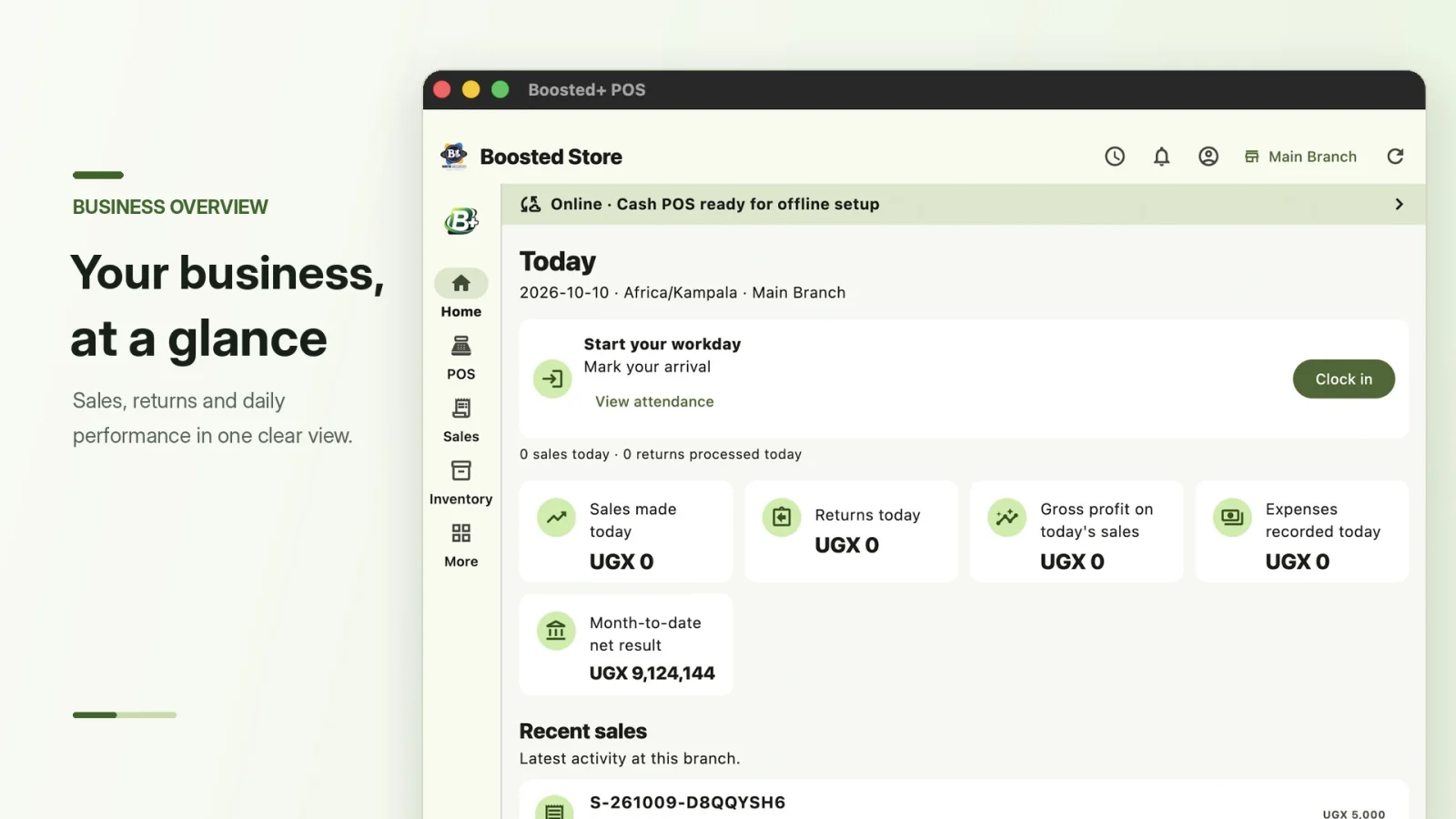
Boosted+ POS, developed by Boosted Technologies Limited, approaches point of sale as part of a wider business operation rather than an isolated cash register.
Designed for Ugandan businesses, it supports retail and wholesale shops, supermarkets, pharmacies, restaurants and hospitality operations, with web and mobile workflows.
Beyond stock tracking, purchasing, sales and reporting, several features address everyday situations that SMEs encounter:
Credit selling: Business owners control which customers receive credit, their limits and repayment records.
Owner's courtesy: Complimentary items can be recorded without falsely treating them as cash sales, while keeping stock and costs accountable.
Sales returns and exchanges: Record returned items, refunds or exchanges with their effects on stock and business records.
Invoices and quotations: Prepare professional documents with business branding.
Staff attendance: Manage check-ins, working shifts and staff accountability.
Flexible payments: Record cash, Mobile Money, mixed payments and supported payment arrangements.
Inventory and reporting: Monitor purchases, stock movements, customer balances, expenses and financial performance across branches.
Consider a small supermarket where a regular customer buys goods on credit, another customer returns an item bought yesterday, and the owner offers a complimentary product. Those activities should not simply disappear into discounts, missing stock or unexplained cash differences.
This is the kind of business visibility Boosted+ POS is designed to provide.
Strength: Its connected approach to customer credit, courtesy transactions, returns, attendance and sector-specific operations makes it particularly relevant to growing SMEs. The core POS is also designed to be free to start.
Weakness: Businesses requiring fully offline checkout or direct URA EFRIS integration should confirm the available workflow before adopting it. Optional integrations and specialised services may involve additional costs.
Best suited for: Retail shops, mini-supermarkets, wholesalers, pharmacies, restaurants and business owners looking to manage more than daily checkout.
Explore Boosted+ POS and get started
Why retail shops must remain central to POS development
Uganda's retail ecosystem includes small neighbourhood shops, kiosks, boutiques, hardware stores, mini-supermarkets and wholesale outlets.
These businesses do not necessarily need complicated enterprise software. They need systems that can answer practical questions: What sold today? Who owes us money? Which products are running out? What was returned? How much profit did we make? Who was responsible for the transaction?
A good retail POS should make these answers accessible without requiring the owner to become an accountant or IT specialist.
The same principle applies to specialised businesses. Restaurants require tables, orders and kitchen coordination. Pharmacies need better batch and expiry tracking. Wholesalers need flexible pricing, purchasing records and customer account management.
The software should adapt to the business, not force every business to operate in the same way.
What should you check before choosing POS software in Uganda?
Price matters, but businesses should also consider reliable local support, internet requirements, staff permissions, stock accuracy, Mobile Money reconciliation, customer credit, returns and long-term running costs.
Businesses subject to URA's Electronic Fiscal Receipting and Invoicing System (EFRIS) requirements should verify that the proposed software supports their actual compliance workflow. An ordinary printed POS receipt should not automatically be treated as a URA fiscal receipt.
Most importantly, request a demonstration using transactions similar to those your business handles every day.
Final thoughts
There is no single POS system that perfectly suits every Ugandan business.
Some solutions are better suited to offline desktop counters. Others focus on tax compliance, mobile selling or more extensive financial management.
At Boosted Technologies, our interest in developing Boosted+ POS comes from recognising that business management goes beyond recording a sale. Customer relationships, stock losses, courtesy transactions, staff accountability and accurate records all matter.
For SMEs moving away from manual books or disconnected spreadsheets, the right technology should simplify operations while giving the owner greater control.
Explore Boosted+ POS and see how your business can manage its daily operations in one place.
Editorial disclosure: Boosted Technologies Limited develops Boosted+ POS. Competitor assessments are based on publicly published product information available in October 2026, not independent hands-on testing. Capabilities, prices and availability may change. Product ordering does not represent a verified market-share or performance ranking.
Join the conversation
No published comments yet.